
Redbad
Legendary king of Frisia
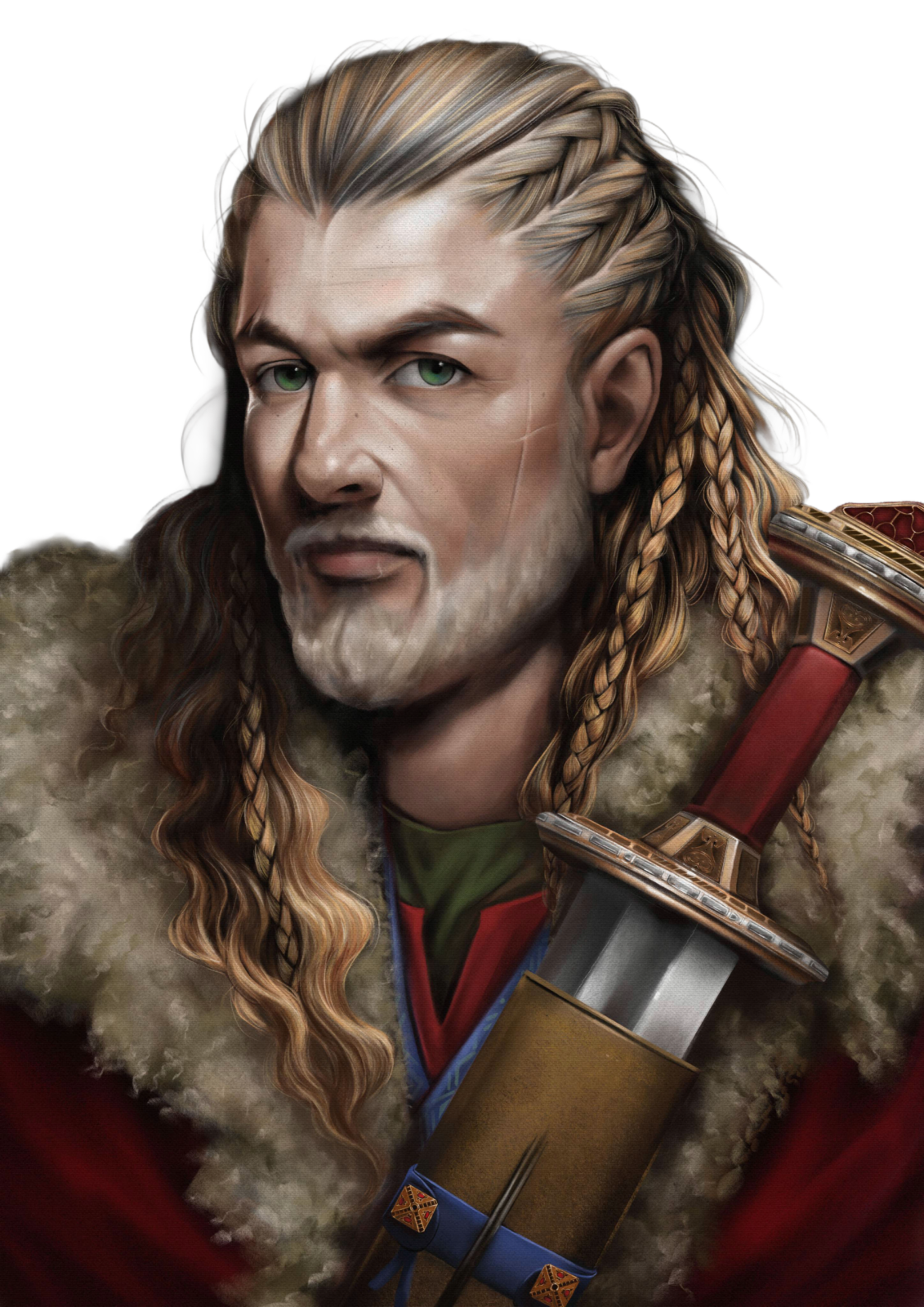
Around the year 700 CE, a legendary king ruled over the great kingdom of Frisia. His name was Redbad, the greatest king these lands have ever known. More than a thousand years after his death, we still know his name. And for many centuries, he has been the subject of many stories and legends.
But who was he really? The mighty ruler who stood against the Franks? The defeated king who had to bow down to those Franks? The stubborn heathen who refused to be baptised? The dreaded enemy of the Catholic Church? Or perhaps… all of the above?
King of Frisia
Redbad was King of Frisia from around 680 CE until his death in 719 CE. His position as king was never guaranteed. Not only did he have to defend his throne against external enemies, such as the Frankish Pepin, but he also had to keep his vassals content. Redbad ruled over a vast territory (from Zeeland to Germany) and historians believe he did so as high king, a ruler who united various regional leaders and their territories into a single powerful coalition.
Pepin
In the south, bordering Redbad’s realm, ruled Pepin II of Herstal, the ambitious ruler of the mighty Frankish Empire. The Franks sought to expand their influence, but Redbad also had ambitions of his own. This led to fierce conflicts, the most famous of which was the Battle of Dorestad. Redbad lost the battle there, but he continued to fight and would later assemble a new army.
Redbad's world
In Redbad’s Frisia, people dealt and lived with the water, wolves and Woden. Woden is the Frisian name for the god Wodan, as we know him from Scandinavia. Ancient texts and Frankish sources paint a picture of a harsh existence characterised by human sacrifice, slavery and great social inequality. But they also depict a world imbued with spirits, featuring sacred animals, rituals and nature gods.
However, this age-old way of life was under threat. In Redbad’s time, missionaries sought to convert the Frisians to Christianity, a religion that vehemently rejected their ‘pagan’ customs. They travelled through the region preaching, attempted to establish monasteries and small churches, and enticed Frisians to the baptismal font with substantial rewards.
His death
In 719 CE, Redbad died after a long deathbed. The story goes that Christian missionaries made one last attempt to baptise him, but to no avail. The Frisian king held fast to his own faith and chose his ancestors in the pagan Walhalla over the Christian Heaven. It is not known who his wife was, although we do know that he had a daughter named Theudesinde. She married Grimoald, a son of Pepin, in what was probably a political marriage.
After his death
After that, this legendary king is mentioned several more times in writing, and myths begin to take shape.
- His sword, Asbran, is said to have been given to him by a sea god. And after Redbad’s death, it was to be thrown back into the sea.
- Although there was no evidence, Redbad was suspected of the murder of Grimoald, Pepin’s son.
- The fact that Redbad refused to be baptised at the very last moment became a heroic tale for the Frisians and a cautionary tale used by the missionaries.
- A 13th-century map, and later one from 1692, appear to show so-called ‘Robodes roads’. These are perfectly straight lines on the map, said to represent the path to a throne on which only the god Woden was permitted to sit.
- It is said that Redbad is still ‘sleeping’ underground until the Frisians need him again, at which point he will awaken.
- His grave has never been found, although it is said that he may be buried in East Frisia, near the Upstalboom, or on the island of Bant (which has now been swallowed up by the sea).
Unreliable sources
Most of the stories from Redbad’s time were not told by the Frisians themselves. In 7th- and 8th-century Frisia, stories were not written down but passed on orally or sung.
All the stories about Redbad therefore come from others. They were usually Frankish enemies or Christian clergy who recorded the events, sometimes decades or even centuries later. Their accounts often reflect their own norms and values, which is why Redbad went down in history through the lens of a unfavourable, Frankish perspective.
MythWatch and this website were developed in collaboration with academics from the REDBAD project. The project also includes a book for the general public, an exhibition and an academic book. So you can always delve deeper into history!