
Holy sites and rituals
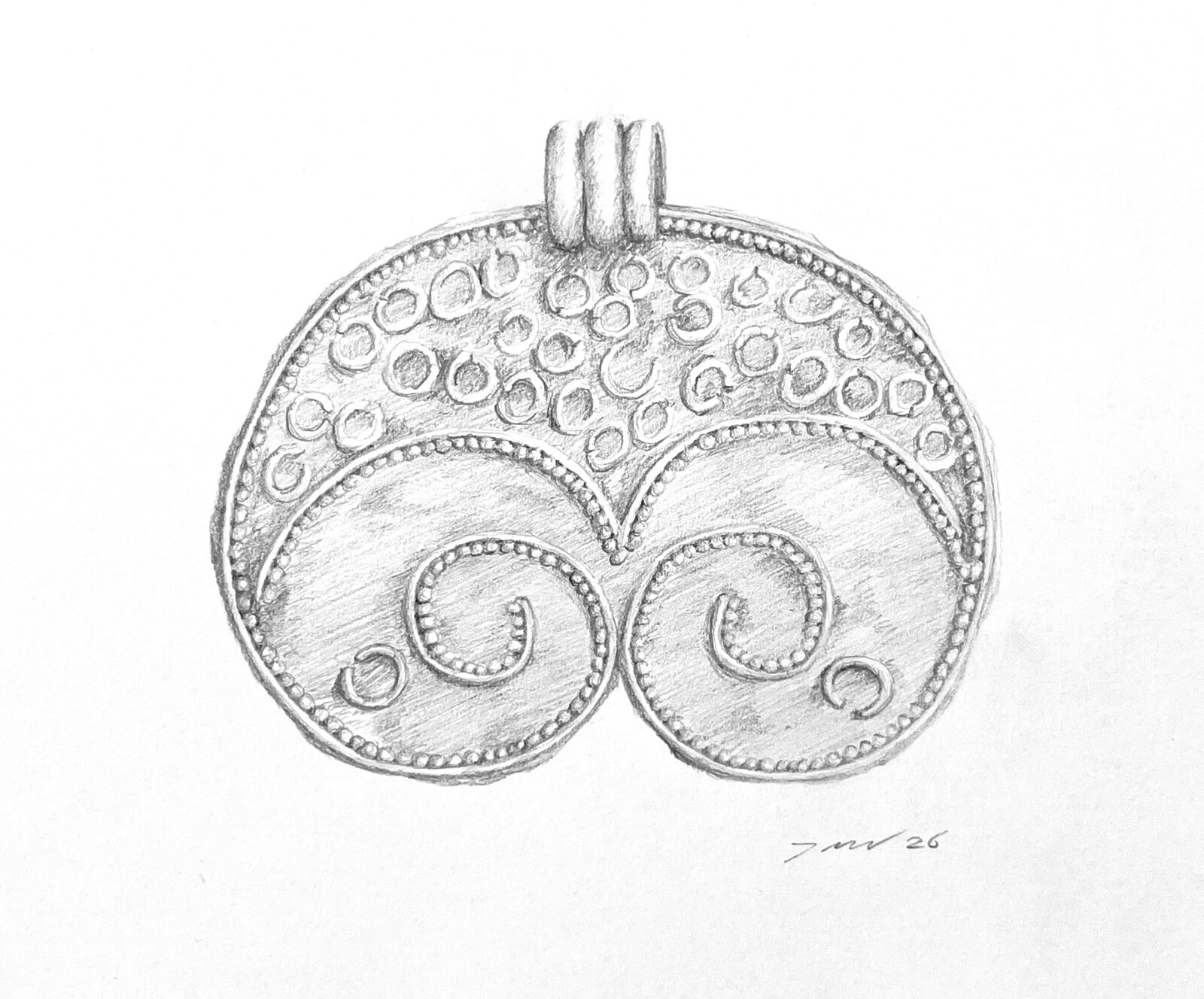
Donar pendants, or in this case, more accurately known as Thuner pendants, have been found, amongst other places, in an ancient pool in the Broekpolder in North Holland. This is no coincidence, as other amulets were also found there, such as dice and other objects that had been deliberately left in the water. It must have been a sacrificial pool, one of the ‘pagan’ sanctuaries mentioned in Christian texts, just like the sacred pool that Willibrord encountered on Fositesland.
In pre-Christian religion, water was clearly regarded as a kind of gateway to another world. The death penalty for anyone who desecrated a sanctuary was to be carried out at the transition between ebb and flow, apparently when contact with the gods was clearest. Perhaps the irreversibility of the sacrifice in water also played a part; once something had been left in a pool or marsh, it could never be retrieved.
There must have been many more places in the natural world that were revered by the Frisians. Sacred trees also fit the picture. The name Heiloo, a village in North Holland, literally means ‘sacred forest’. Place names invariably provide interesting references to ancient traditions associated with such places. Harich in Fryslân and Hargen in North Holland both contain an Old Frisian word for ‘sanctuary’. Gods are also sometimes referenced, as evidenced by place names such as Woensberg (North Holland) and Donderberg (Utrecht).
A pond has also been discovered near the Upstalboom in Aurich. This site, where justice was administered in the 11th century, is still associated with Redbad.
‘Indiculus superstitionum et paganiarum’. The Codex Palatinus Latinus, dating from 577 CE, provides us with a brief list of superstitious and pagan customs. These superstitions are viewd from a Christian perspective, but nevertheless grant valuable insights into which rituals were important to Frisians.
1. On blasphemy at the graves of the dead.
2. Regarding blasphemy against the dead, called 'dadsisas'.
3. On filth in February (spurcalibus).
4. Over hutten of godenhuisjes (fanis).
5. On sacred sites in forests, known as nimidas.
6. On what they do on rocks.
7. On the sacred sites of Woden and Thuner (Mercury or Jupiter).
8. On the sacrifices for certain saints.
9. On amulets and charms.
10. On sacrificial ponds.
11. On magic spells.
12. On omens involving birds, horses, cattle dung and sneezing.
13. On fortune-tellers and soothsayers.
14. On the creation of fire by rubbing wood (nodfyr).
15. On the brains of animals.
16. On what the pagans see in the fire, and when they begin something.
17. On obscure places which they regard as sacred.
18. On the festivals of Thuner and Woden.
19. On the lunar eclipse known as the ‘vinceluna’.
20. On horns and cups.
21. On the ditches surrounding the villages to keep evil spirits out.
22. On the pagan procession known as the ‘yrias’, with tattered rags and shoes.
23. On the fact that they regard a beloved deceased person as a saint.
24. On the idol made of dough.
25. On idols made of rags.
26. On the statue of the god they are carrying through the fields.
27. On wooden feet and hands in pagan rites.
28. On their belief that women can read the moon, enabling them to steal people’s hearts.