
The rules
MythWatch is a cooperative tabletop role-playing game. You play a Mythmaker: someone with a real connection to the past and capable of experiencing those stories firsthand. These stories are tied to real history, places, and objects.One player takes on the role of the Guide. The Guide describes the world and what happens in a story. The other players describe how their characters react to those events. In other words, the story is decided through the creativity of everyone at the table. Well, sometimes fate can give a little push as well. You see, whenever a character wants to do something risky or that would have dire consequences should they fail, it is time to roll some dice. You roll a number of dice based on your character’s Characteristics and the result determines how well (or how badly) the action plays out.
The rules of MythWatch exist to support the story; so that you and your group gets to share an adventure together. In fact, the rules are only meant as guidelines, and you should feel free to decide together to change them as you see fit. What matters most is that the story keeps moving and everyone has fun!
Stunt
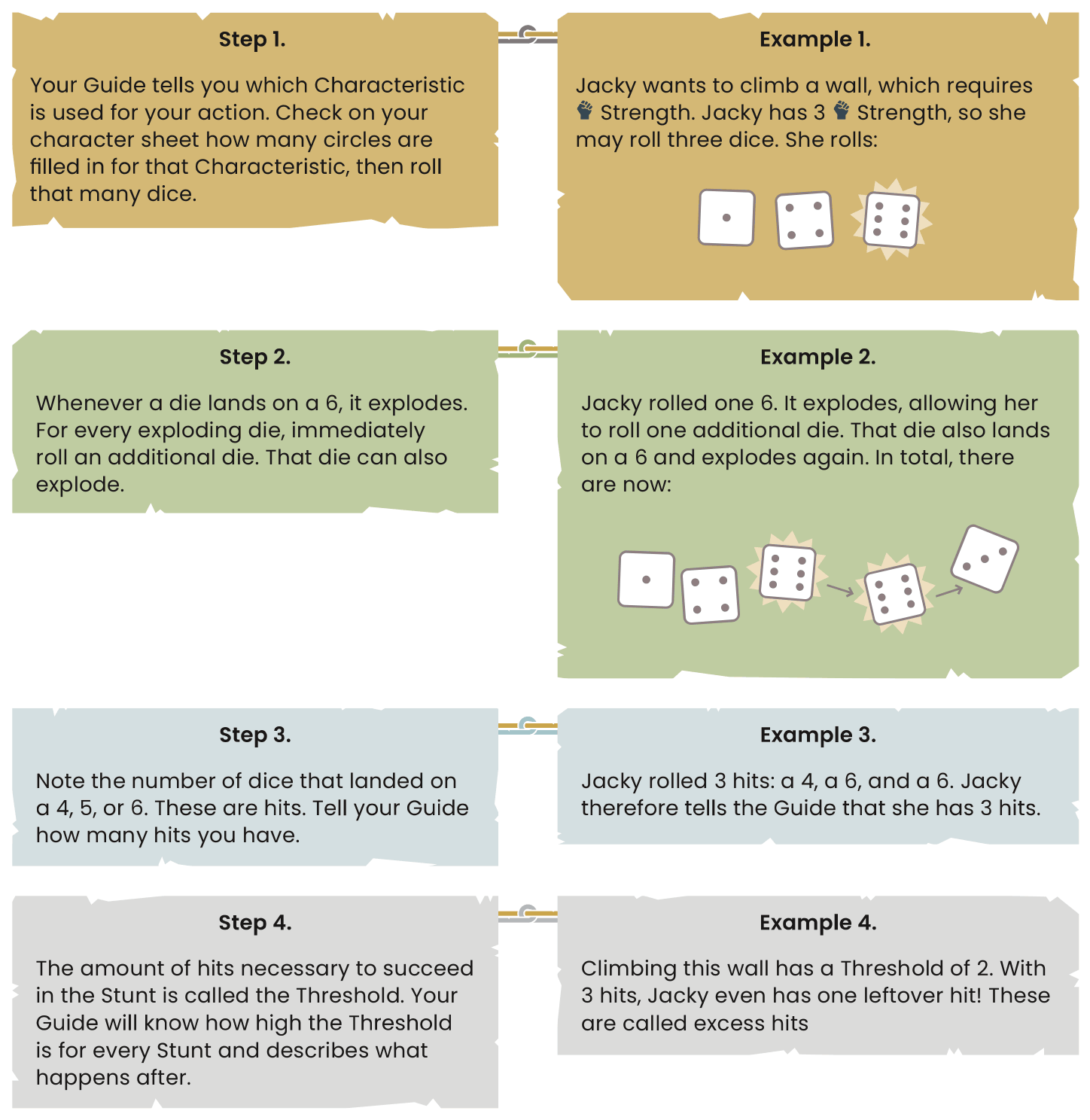
MythWatch is a collaborative adventure: your Guide sets the scene, you describe what your Mythmaker does, and the Guide again describes how the world responds. As long as your character is doing ordinary, mundane things, the story unfolds naturally and there is no need to roll dice. Only when you attempt something risky, something that could fail and/or have significant consequences, do the dice come into play. This is called a Stunt.
Excess hits
Each hit above the Threshold is called an excess hit. The more you have, the better. You can trade excess hits to complete the Stunt in a better, faster, or more effective way. A good guideline is you perform the Stunt exceptionally well with 3 excess hits or more!
Fate dice
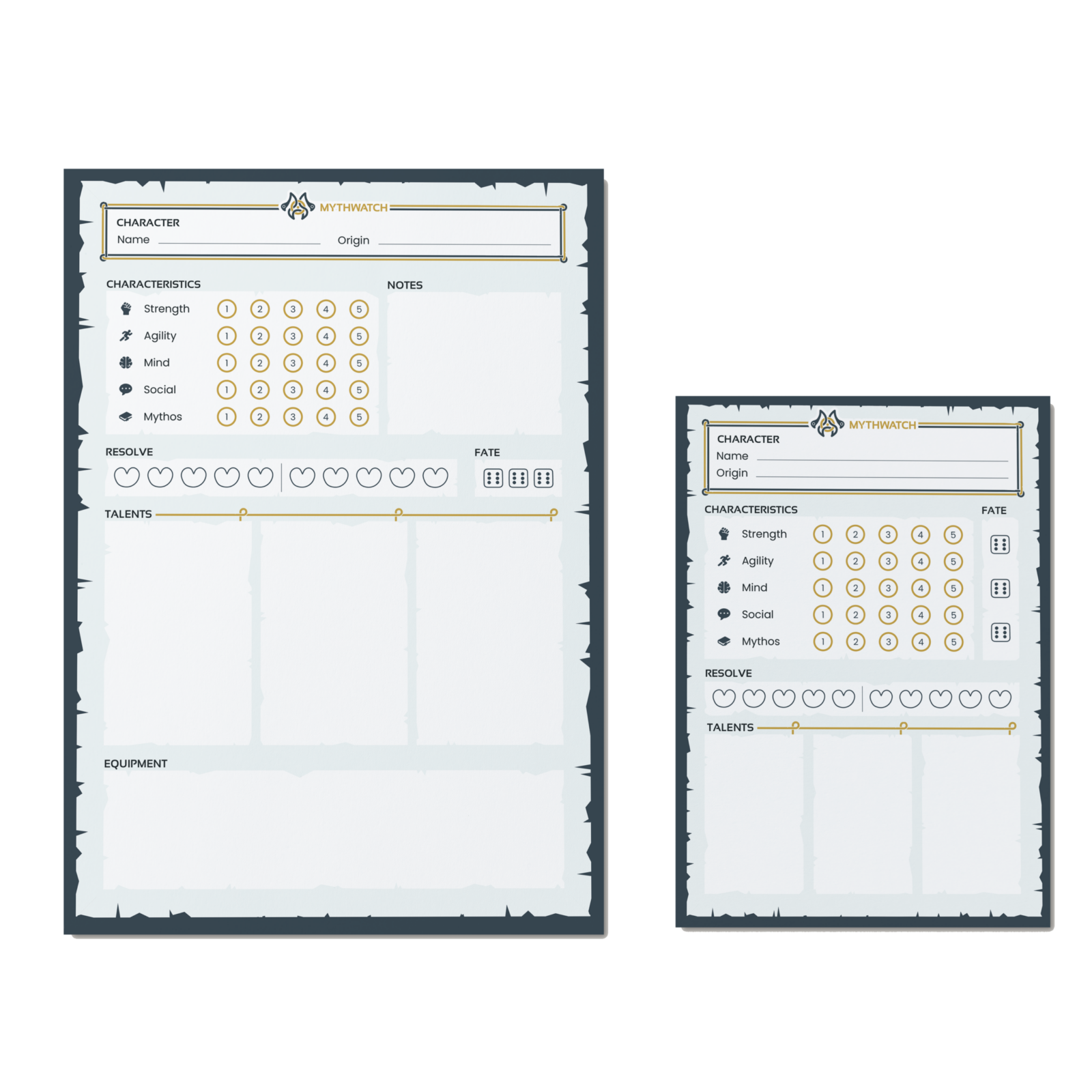
Each Mythmaker has 3 fate dice at their disposal. This is an extra resource you can use to increase the odds of success. Whenever a player wishes to spend a fate die, they must say so before rolling for a Stunt. They then add one additional die to the Stunt. You may only use one fate die per Stunt. However, you can also spend them on or receive them from fellow players. This is one way your Stunt can benefit from multiple fate dice.
Turns
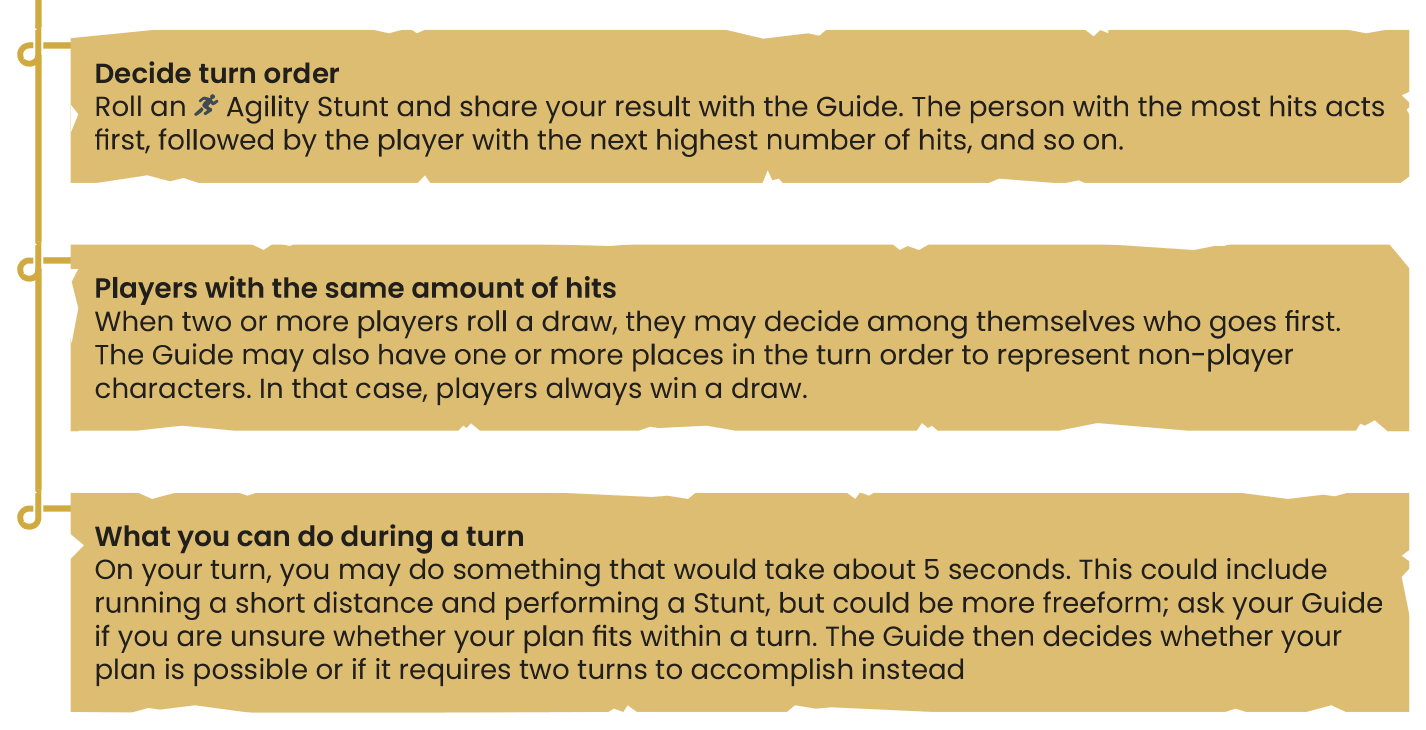
MythWatch generally does not need to be played in game turns. But sometimes scenarios are time-sensitive, such as when fighting fires or during chases or combat. Whenever that is the case, players should determine turn order and describe their actions one at a time. One turn typically lasts about 5 seconds in the game world.
MythWatch generally does not need to be played in game turns. But sometimes scenarios are time-sensitive, such as when fighting fires or during chases or combat. Whenever that is the case, players should determine turn order and describe their actions one at a time. One turn typically lasts about 5 seconds in the game world.
Resolve
Resolve is a combination of one’s physical and mental state and willingness to keep going. Mythmakers have 10 Resolve. You typically lose Resolve in situations where failing a Stunt logically results in a hit to your mental or physical condition.
The Guide determines when and how much Resolve you lose. Your character restores 5 Resolve after a good night’s sleep.
Every time resolve drops to 0, the following happens:
- Step 1. You receive a Major Setback card. Your allies then each lose 2 Resolve. If you now have two Major Setback cards, the story ends for your Mythmaker.
- Step 2. Perform a Mind Stunt and recover an amount of Resolve equal to the number of hits, with a minimum of 1.
Print material
Want to pick one of the premade characters? Or do you need an empty character sheet to make your very own? Or maybe you're looking to print your own status cards? All you need can be found here!
Pre-made characters
Lege personage-bladen
Play cards
Glossary
- Anchor: A Mythmaker’s object of personal or sentimental significance that makes it easier for them to return to their own time period.
- Characteristic: One of five attributes that determine how many dice you generally get to roll.
- Excess hit: Every hit above meeting the Threshold. These extra hits can often be traded for better results.
- Experience Point: Points earned by playing, representing your character’s personal growth. They can be used to buy new Talents.
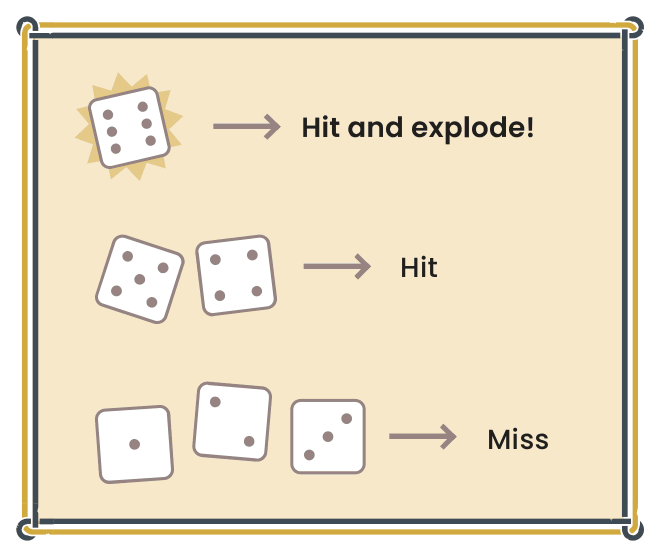
- Explode: When a die rolls a 6, it explodes; you may roll the die again, potentially gaining another hit, or even exploding again when it too rolls a 6.
- Guide: The person at the table who tells the story. The Guide steers the game in the right direction and acts as a referee when necessary.
- Hit: When a die rolls a 4, 5 or 6.
- Module: A set of optional rules. Add these to the base rules to enhance certain aspects of your story.
- Mythwatch: The organisation of Mythmakers, with a shared goal of protecting myths and legends to ensure its lessons are not forgotten.
- Origin: A package of Talents and equipment, giving flavour to who your Mythmaker is and where they are from.
- Resolve: A combination of your physical and mental readiness to keep going.
Stunt action: A risky action with harsh consequences for failing. Creativity is often rewarded.
- Talent: Something your Mythmaker is particularly good at, that gives specific situational benefits.
- Threshold: The number of hits required to successfully complete an action.
- Turning Point: A moment introduced by your Guide, which allows you to recover from or prepare for a significant point in the story.